Chinese Porcelain Figurines
What type of Chinese porcelain figurines or statues do we find mostly in Chinese culture?
There are two basic groups, one is for the living, the other for the dead. The former was found since old times on altars, etc., while most of the purely decorative items were made in more recent times. The latter are figures used in burials since ancient times.
Overall, the Chinese porcelain figurines remaining today indicate that these found only limited use in ancient China. Purely
decorative items are relatively rare and more recent. Most of these can be categorized
as follows:
|
Religious
People
Birds
Produce and other real-life items
|
Longquan Buddha figure 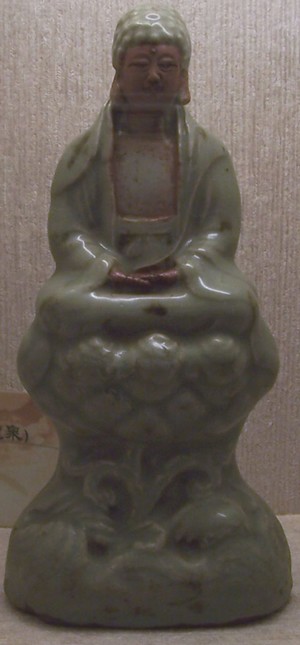 (courtesy Xiangtai Coll., Jiayi) |
Two kilns well known for Chinese porcelain figurines
Shiwan and Dehua kilns are especially noted for their long history in producing figurines.
- Dehua kiln has been producing blue and white porcelain. Since the Ming
dynasty it became increasingly famous for its pure white figurines
depicting Guanyin, Boddhisattvas, Lohans and other mostly religious
human figurines.
Note: The term "Blanc-de-chine" is a term used for the white porcelain items produced by this and other kilns. Blanc-de-Chine requires a pure, white clay and white glaze. - Shiwan figurines are mostly glazed earthenware, they are not really porcelain. With human figures frequently only the clothes and other items are glazed, while exposed skin like the face, hands and feet remain unglazed. These figurines depict mostly common people in everyday life.
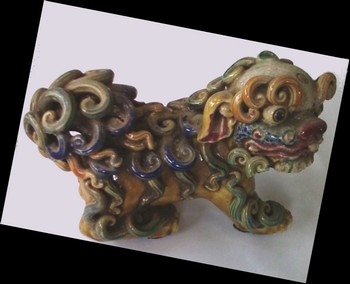 |
Old Shiwan Lion |
Later Figurines
Only in the first decades of the 20th century the production of
porcelain figurines other than those from the two kilns above did increase
considerably. Many of the older ones seen today were made at
Jingdezhen during that period in the first half of the 20th
century. The other are either vintage or newer products from the second half.
There were work shops specialized in human figurines (incl. deities, Buddhas), while others are known to have mainly produced birds and animals only.
Lions
Foo Dogs aka Lion Dogs are western terms. In Chinese they are all called just lions. Usually they come in pairs, the male has its foot on a ball, the female on a cub.
Like many other figurines they are more frequent in the 20th century. Some may have been earlier, but the majority of figurines was produced in the 20th century. They are still being made as they are auspicious animals.
Large lions are frequently found to the left and right of gates and entrances, either as stone carvings or glazed ceramics. They are considered guardians warding off evil, in Chinese culture.
Home » Chinese Porcelain Figurines
| About | Queries | Disclaimer | Privacy Policy | Sitemap | Sponsorship Policy |
