Chinese Imari Porcelain
Chinese Imari - What is it?
This name is used for a pattern and/or colors given to a specific type of Chinese export porcelain. That was imitating those of Japanese Imari wares.
During the early years of the Qing dynasty, in the 17th century, the imperial court imposed a sea
prohibition, virtually banning all trade with foreign trading entities or countries. The purpose was to prevent that the forces of Zheng Chenggong (鄭成功), a Ming loyalist then based in Formosa (Taiwan), could try restoring the Ming dynasty by attacking the Qing on the mainland. Zheng at the time had ships while the land-based Qing had none.
This prohibition interrupted all activities on the sea, including trade.
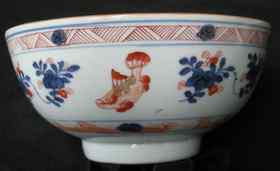 |
Imari bowl |
These ceramics made by kilns on the southern Japanese island of Kyushu
were exported via a port called Imari, hence the name given to the
Japanese porcelain bought by the Europeans.
After the majority of the porcelain exports shifted from Ming China to
Japan, the Japanese kilns first copied Chinese patterns and produced
similar decorations as China, gradually changing them to more Japanese style
patterns.
However, after the sea prohibition (sea ban) was lifted, and aided by Japan's
seclusion imposed by the Tokugawa shogunate at about this time, Chinese kilns didn't waste any time to grab much of the
export business back.
|
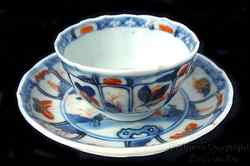
In order to conform to the taste of these Imari patterns the Chinese
kilns initially copied the Japanese Imari patterns to be able to
re-enter the European export market. Therefore, some of the very early Imari patterns on Chinese porcelain look almost exactly like Japanese patterns. |
 |
Due to the above reasons and time of its origin, this porcelain pattern is most
abundant in export porcelain of the early Qing dynasty, especially the
Kangxi reign (1662-1722), when the bulk of the porcelain trade shifted
back to China.
| About | Queries | Disclaimer | Privacy Policy | Sitemap | Sponsorship Policy |
